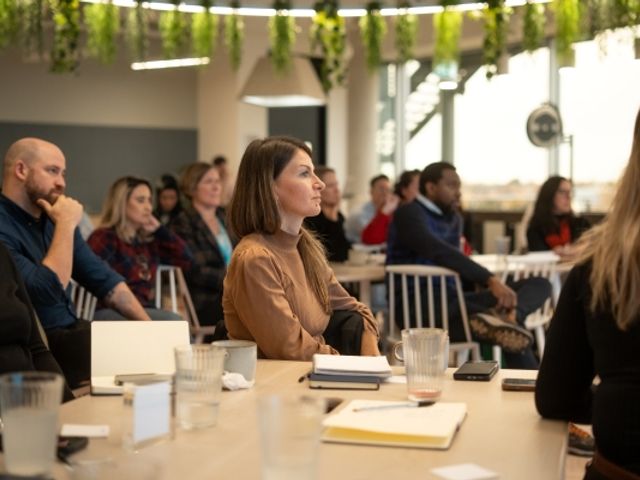
This year’s Global Business Travel Association's (GBTA) VDR Conference in Hamburg brought together travel leaders from around the world for yet another inspiring, educational and collaborative three days.
From geopolitical shifts and groundbreaking sustainability commitments, to advances in AI, opportunities for corporate housing and everything in-between, this year’s sessions underscored one thing clearly: volatility is here to stay, but collaboration, innovation, and data-driven strategy are helping organisations build stronger, more resilient travel programmes than ever before.
This year, Synergy was proud to exhibit alongside our new colleagues at SilverDoor, and as always, came back fresh with insights and more passion than ever for our industry. Below, our team share their key takeaways from the three-day event.
The Global Economic Outlook Encouraged Business Travel Leaders to Prepare for a Fragmented Future
The global economic outlook session painted an uncertain picture of what lies ahead: a world entering its most significant geopolitical and financial confrontation in decades - with the U.S. and China at the centre.
During a spotlight on China’s continued global rise, key figures emerged highlighting the country’s recent acceleration including its place as the largest trading partner for 122 countries and leading 37 of 44 critical future technologies. It was also noted that China aims to bring two-thirds of nations into its economic orbit by 2049. For geopolitics, this highlights the continued influence China will have on global political and economic stability as we look ahead.
When discussing the impact on travel and corporate housing programmes, speakers identified an opportunity for businesses to get ahead of elements such as cost fluctuations and increased scrutiny of travel ROI. For travel managers, this could mean choosing travel suppliers whose operations are flexible and agile enough to adapt their services to the cost-aware environment in which business travel exists.

Technology and AI Prevail as the “Next Normal”
Another major theme from Hamburg was the accelerating intersection of technology and AI. Digital is now the default, and travellers expect speed, clarity, and convenience at every touchpoint. With over five billion people online and near-universal mobile use, speakers highlighted offline time is almost obsolete.
When exploring AI, it was clear adoption is surging across the travel ecosystem, with up to 70% of European suppliers now trialling or deploying agentic AI. Importantly, leaders across sessions emphasised that AI is designed to augment and not replace, therefore freeing teams to focus on empathy, problem-solving, and service excellence.

Despite advances in tech, human touch has remained instrumental, particularly for human-led industries such as corporate housing. Speakers warned against over-automation, reminding the audience that emotional intelligence and human connection still play a vital role, especially in moments of disruption or stress.
Take a listen to Synergy & SilverDoor’s most recent podcast which dives into AI’s growth across business travel with industry experts Jennifer Steinke and Greg Wilczek.
Opportunities Lie Ahead for Business Travel Accommodation
The accommodation panel, which included Synergy & SilverDoor’s Sofia Oragano, took a fast-paced, interactive approach to tackling some of the industry’s most debated topics. The conversation opened with the future of the hotel RFP, where both buyers and suppliers agreed that annual RFPs are too manual, too slow, and too disconnected from real-world demand.
The panel later highlighted the future lies in data-driven, continuous sourcing supported by smarter technology and AI, agreeing there was an opportunity to leverage AI and predictive technology in serviced accommodations to reduce operational noise, free up time for strategy, and support employees with faster, more personalised guidance.
Speaking to the serviced apartment industry Sofia shared “automation and technological advancement remain top business travel priorities. However, when it comes to extended-stay, personalisation is everything. With longer stays come more unique requirements and its imperative we leverage technology to cater to, and deliver on, individual preferences. It’s about creating a tailored experience that truly enhances the guest journey and delivers on programme ROI.”
Payments and billing sparked similar energy, with virtual cards continuing to be a major friction point despite years of industry effort. Panellists suggested the need for buyers, TMCs, and partners to work more closely to deliver true automation. Dynamic rates within serviced apartments and hotels were another hot topic, with buyers emphasising the need for clarity, transparency, and strong supplier alignment.
Global Airline Trends Highlighted a Jump in Fares and Traveller Experiences
During this insightful session, airline leaders unpacked the forces reshaping how employees fly and how organisations will manage spend in 2025 and beyond.
Business travellers increasingly expect elevated experiences, and airlines are responding. Premium Economy bookings on Europe–Middle East routes jumped 11% and Europe–North America fares are projected to rise 1.8% in 2025. Leaders also noted that business class fares on Europe–Asia routes are expected to increase 4.8% as Russian airspace restrictions force longer flights.
Discussing financial pressures, leaders observed that labour remains the second-largest airline cost, cautioning that rising crew compensation may lead to price increases. Speakers also noted Riyadh's constrained airport capacity continues to keep fares high until the new King Salman International Airport opens.

Advances in Sustainability Provided Some Encouragement
As expected, the environmental sustainability conversation remained front and centre at GBTA Hamburg. Noting the importance the EU Ministry of Transport has placed on decarbonisation, it was no surprise to learn that 80% of EU citizens value environmental impact when they travel. Despite this, only 20% act accordingly, highlighting an opportunity within business travel and serviced accommodations embark on a campaign to drive behavioural change if we want to make real, tangible impact.
Shell’s sustainability spotlight session was one of the most forward-looking conversations in Hamburg, highlighting several landmark initiatives across Europe including Germany’s largest bio-LNG plant, delivering:

In terms of actionable insights, Shell urged businesses to choose SAF-enabled routes, use book-and-claim platforms, leverage Online Booking Tools (OBT) to integrate emissions insights, while consistently stressing the importance of prioritising measurable sustainability impact. Within serviced accommodations for example, this could include leveraging tools like SilverDoor’s Carbon Calculator.
Looking Ahead
In a world shaped by geopolitical tension, rising costs, and rapid digital acceleration, resilience will depend on stronger collaboration between industry stakeholders. Ultimately, GBTA Hamburg underscored that the goal isn’t to eliminate uncertainty but to build travel programmes capable of outperforming it. With smarter tools, deeper partnerships, and a collective drive for responsible, traveller-centred innovation, the industry is well equipped to shape a more sustainable, connected future.