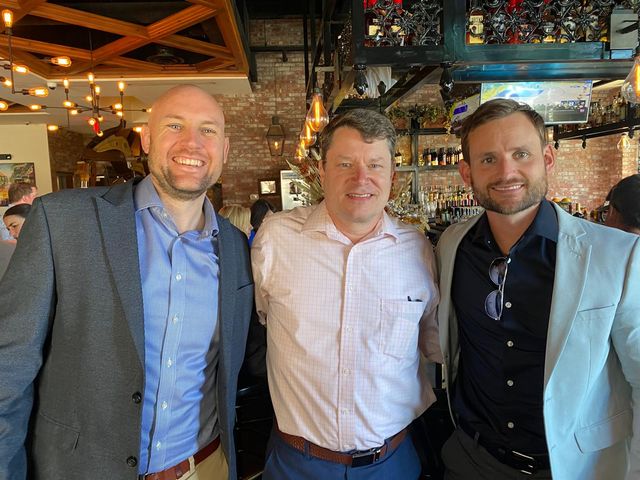
This month, we headed to Salt Lake City, Utah to attend the WERC conference and came back celebrating Synergy’s ESG win. Following our merger earlier this year, we’re so glad to see our growing SilverDoor family going from strength to strength.
Gathering amongst the industry’s leading experts (and in between puppy therapy sessions) we caught up on the latest sector breakthroughs, hot takeaways and impactful insider insights.
Check out my key takeaways below…
“Everything I do is viewed through that lens of wanting to be compliant and instilling a culture of compliance within our employee population.”
- Tom LeBaron - Sr. Manager of Immigration and Mobility – Confluent
Session: From Complexity to Clarity: Mastering Global Immigration Compliance
Speakers: Frannie Snediker - Director of Client Services - Envoy Global, Brendan Coggan - SVP of Global Services - Envoy Global, Tom LeBaron - Sr. Manager of Immigration and Mobility – Confluent, Jill Soubel - Asst. General Counsel, Director of Global Mobility – KLA.
Once upon a time, compliance risks could be managed quietly in the background. Those days are over. Governments are embracing digitisation, from electronic travel authorisations (ETAs) to entry-exit tracking systems and that means the visibility of every traveller has never been higher.
As Jill Soubel of KLA put it, “They know where you are, and they know how long you’ve been there.”
For global mobility managers, that translates into a new form of accountability. Compliance is no longer just about avoiding penalties; it’s about maintaining business continuity and protecting brand integrity.
“Business travel compliance does not start with who can track it. It starts when the business is planning for the person to go.”
- Jill Soubel - Asst. General Counsel, Director of Global Mobility – KLA
Compliance may not sound glamorous, but it’s becoming a key differentiator. Soubel noted that at KLA, compliance is framed as an extension of customer reliability: “If we create a problem for our customer, that’s much worse than getting a slap on the wrist when exiting the country.”
Whether relocating staff, booking temporary housing, or managing short-term assignments, partners that demonstrate strong compliance credentials build trust not just with clients, but with regulators and employees alike.
“I love AI for its helpfulness, but always with the knowledge that it’s not comprehensive and that it’s highly situational.”
- Tom LeBaron - Sr. Manager of Immigration and Mobility – Confluent
Artificial intelligence inevitably entered the conversation, but with measured optimism. As Tom LeBaron from Confluent observed, “AI is not essential for qualified compliance - we’re just not there yet.”
Used wisely, AI can help research policies, detect patterns, and streamline reporting. But it cannot yet replace legal or contextual judgement. The lesson for mobility leaders
Use AI to enhance human expertise, not override it. A mature compliance programme isn’t built overnight. It evolves through consistent planning and reflection. The panel’s checklist was simple:


“Sending people to the same place repeatedly isn’t very complex, but entering new markets is.”
- Morgan Crosby - Chief Strategy Officer - AIRINC
Session: One Size Never Fits All: Designing the Mobility Team Your Program Deserves
Speakers: Christopher Chalk - Head of Global Mobility – GPI, Morgan Crosby - Chief Strategy Officer – AIRINC, Mark Bicocchi - Global Mobility Program Manager – Driscolls, Berna Anderson - Director HR - Global Mobility & HRB – Becton, Dickson and Company
Morgan Crosby, Chief Strategy Officer at AIRINC, opened with an insight that set the tone for the discussion: mobility design isn’t about how many people you have, it’s about the complexity you manage. She encouraged attendees to rethink “cases per FTE” (full-time employee) not as a productivity measure, but as a reflection of complexity.
Simple, high-volume programmes – such as new hires relocating into one country – thrive on automation and repeatability. Low-volume, high-complexity programmes – involving remote work, commuters, one-way transfers, and long-term assignments – require greater expertise, stakeholder alignment, and a hands-on approach.
In short, fifty moves can be harder than five hundred, depending on their variety and visibility.
“What’s important: being strategic or just providing resources?”
- Berna Anderson - Director HR - Global Mobility & HRB – Becton, Dickson and Company
Each panellist described a different approach to team design, shaped by company size, industry, and maturity.
At Graphic Packaging International, Christopher Chalk focused on modernisation. “We saw opportunities to streamline, automate, and cut cost without reducing benefits. Technology was the missing piece – so we built it.”
The common thread here is that mobility excellence comes from clarity of purpose, not headcount.
“We provide tools, experience, and resources, but each company must map it to their culture and business objectives. One size does not fit all.”
- Christopher Chalk - Head of Global Mobility – GPI
A recurring question in every mobility discussion is where the function should report. The panel’s consensus was that there is no single right answer – but placement signals intent.
Reporting through Shared Services tends to make mobility an operational function, focused on efficiency and standardisation. Reporting through HR or Talent elevates mobility to a strategic enabler of career growth, leadership development, and global agility. Reporting directly to the CHRO can enhance visibility and influence across the business.
“We realized there were more questions than answers for most companies, if not all, when defining mobility ROI.”
- Lisa Johnson – Director, Global Consulting – Cartus
Session: Unlocking Mobility ROI: A Strategic Talent Advantage
Speakers: Lisa Johnson – Director, Global Consulting – Cartus , Diane Mullen – Manager, Intercultural Academy, Cartus Intercultural & Language Solutions, Cartus , Ray Kirby – Director, Global Mobility – Qualcomm , Sandy Beyer – Director, Global Talent Mobility – Salesforce
Lisa Johnson of Cartus Global Consulting opened the session by acknowledging the longstanding struggle to define mobility ROI. Is it about cost savings, productivity, or assignment success?
Across focus groups, one theme consistently emerged - the strongest ROI comes from aligning mobility with talent strategy. The most successful programmes directly support:

“I often say an international assignment isn’t a success until repatriation is a success.”
Diane Mullen – Manager, Intercultural Academy, Cartus Intercultural & Language Solutions, Cartus
Diane Mullen of Cartus Intercultural & Language Solutions offered a striking statistic:
“40% of repatriates leave their jobs within a year if not supported. The cost of turnover can reach 200% of salary.”
Repatriation is often overlooked, yet it’s where much of mobility ROI is either realised or lost. A well-planned return can transform an assignee into a global leader and mentor. A neglected one can lead to attrition and lost investment.

“There isn’t a magic formula. ROI could be cost, retention, or meeting assignment metrics.”
Sandy Beyer – Director, Global Talent Mobility – Salesforce
The session’s interactive breakout asked attendees to map their stakeholders and their communication cadence.
Mobility doesn’t operate in isolation; it intersects with Talent Acquisition, HR, Legal, Tax, Suppliers, and Families. Each of these groups experiences ROI differently, faster onboarding, reduced costs, improved compliance, or stronger engagement.
The takeaway: build your own Mobility ROI dashboard that reflects what your stakeholders actually value. Track metrics such as:

Attending events such as WERC are not only an incredible opportunity for our team to connect with partners and industry leaders, but to be empowered by the shared insights. Using our growing network to bolster our industry knowledge further helps us predict and support our clients. To get in touch with our expert accounts team for more information about properties that should be on your radar, contact us today! We’ll be sure to be keeping an eye out for these trends coming into 2026…