Most of the population is aware of the importance of sleep but the specifics of its profound impact on day-to-day work - such as boosting concentration, aiding decision-making and emotional resilience - are often overlooked and at the very least, deprioritised.
Whether you’re at home or travelling for work, the negative effects of poor sleep permeate every aspect of the day, impacting not just your productivity, but the performance of those around you. That’s why prioritising a high-quality sleep environment becomes essential to both personal and professional success.
Let’s explore the science behind how better sleep could improve your performance, and some practical ways to action this, especially on a business trip.
________________________________________________________________________________________
What are the Consequences of Poor Sleep?
Sleep is the best remedy for both physical and mental recovery. Getting the recommended 7 to 9 hours of sleep per night supports the healthy upkeep of every bodily system, giving you the best chance to perform at 100%.
The University Medical Centre Freiberg explored this in a recent study, finding that:
-
Sleep deprivation causes a major change in brain connectivity and functionality
-
Tired participants require a much weaker signal to trigger muscle movement – meaning the brain is more excitable and less efficient
-
In memory-based tasks, sleep-deprived individuals performed poorly, proving how essential it is for the brain to take a rest from synaptic strength and recalibrate via sleep
What does this mean for your work?
Simply put, less sleep results in poorer cognitive application – poorer memory, slower decision making, less alertness and a greater struggle with simple tasks. Not ideal for a productive day’s work!

Insufficient sleep has profound implications on your long-term physical health, too, with repeated insufficient sleep linked to increased health complications.
Over a third of adults fall outside the optimal 7-9 hours of sleep per night. Be it the result of the ‘#grindset’ attitude or ‘hustle culture’, it seems something is getting in the way of quality rest.
Disrupted Routines and The Rise of ‘Social Jetlag’.
One of the biggest culprits? ‘Social jetlag’ - a topic Phil Learney explored at our 2023 Partner Engagement Day. This is where the pace of modern life misaligns with our body’s natural rhythms leading to irregular sleep patterns.
The demands of work, commuting, upset routines during business travel, or even late-night screen time all play a part.

“To combat the struggles of balancing a fast-paced modern lifestyle with the need for sleep, turning your focus to practicing good ‘sleep hygiene’ becomes hugely beneficial. Sleep hygiene refers to proper habits and routines that promote both good sleep quantity and quality.”
Blurred lines between business and leisure, propagated by popular trends like working-from-home (WFH) and ‘bleisure’ travel, further contribute to this ‘social jetlag’.
- In 2019, just 4.7% of the UK’s workforce were WFH, compared to 2025, where almost a third adopt either a hybrid working style or work exclusively from home.
The many financial and time-saving benefits of the WFH and ‘bleisure’ lifestyles (not to mention the increased job opportunities and accessibility) also come with the overlooked drawbacks of social jetlag, encroaching sleep-deprivation.
Our recent LinkedIn poll echoes these concerns...
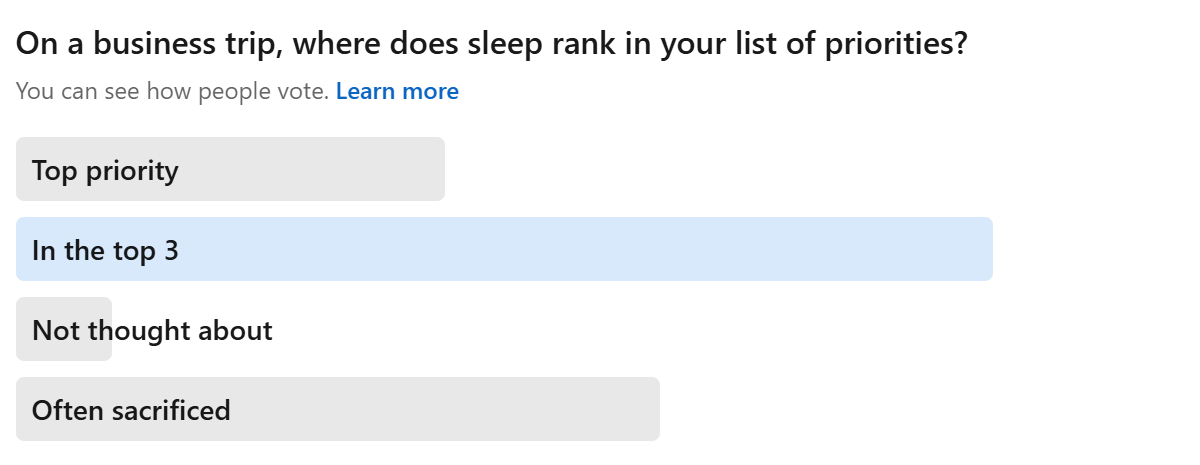
- ‘A third of respondents said that sleep is ‘often sacrificed’ on business trips’
- ‘Half of our network ranked sleep in their top 3 travel priorities’
The result of all this disruption? A subconscious cycle of stress: a poor night’s sleep that leads to an unproductive day, triggering a late-night work session to compensate -increasing your stress and further disrupting your sleep. This pattern often comes to a breaking point with;
- 63% of UK employees showing signs of burn-out like exhaustion, in 2024 (up 10% from 2022)
- And a staggering quarter of UK workers report feeling unable to cope with workplace stress.
Be it a conscious choice or not, when we neglect the value of sleep, we suffer. Trends like ‘#grindset’, ‘hustle culture’, ‘WFH’, and ‘bleisure’ aren’t expected to stop anytime soon, so a better understanding and adaptation of our sleep habits becomes paramount to achieve the success we strive so hard for.
What Can You do to Improve Your Sleep and Work Performance?
To combat the struggles of balancing a fast-paced modern lifestyle with the need for sleep, turning your focus to practicing good ‘sleep hygiene’ becomes hugely beneficial. Sleep hygiene refers to proper habits and routines that promote both strong sleep quantity and quality. Two of the most important aspects of this are;
- establishing routine (avoiding ‘social jetlag’)
- curating an environment conducive to sleep
This can be tricky as a business traveller; adapting to a new location which unsettles your usual sleep patterns and customs.
Here’s Why Corporate Accommodation Has the Edge...
Achieving good sleep hygiene is undoubtedly where corporate accommodation trumps other accommodations.
- With all the typical amenities that you’re used to, they’re designed with a ‘home like’ feel so you can settle in right away and maintain your usual routine at your own pace - step one to solid sleep hygiene.
Tailored to meet specific needs
- With options for separate rooms for working, dining, and relaxing, a serviced apartment offers far more privacy and space than a hotel. This allows you to create that all-important physical divide between the working day and the beginning of your nighttime routine with a specific, curated area to unwind and relax before bed - step two to solid sleep hygiene.
Furthermore, once you are actually asleep, a serviced apartment is the perfect place to ensure deep sleep, having typically much less noise compared to a hotel. With fewer shared walls, less corridor traffic, and less transient stays, your night will remain undisturbed, prompting REM sleep – crucial for the cognitive rest and recharge we discussed earlier. Providers like Bob W are already showing their commitment to reducing noise by integrating smart-technology like Minute into their serviced apartments, seeing 83% of loud noises solved after one notification.
Alex Hassett, our Partner Acquisitions Specialist, makes SilverDoor’s commitment to quality sleep clear, as we “look for blackout curtains to block external light, as well as soundproofing or a location away from busy streets and communal areas.” Put simply, “for consistently strong sleep quality, a serviced apartment will always outperform a hotel room.”
Despite how obvious it seems, sleep is often the first thing sacrificed on a business trip - but it’s the one thing that can most significantly improve its success.
Serviced apartments offer the comfort, space, and privacy needed to recharge properly – explore our full portfolio here or, get in touch with our team today to find out how best we can meet your business travel needs.
Your business trip being a success or failure could hinge on the quality of your sleep. Set yourself up for the day ahead, settle into a serviced apartment.