Austin, Texas, played host to CHPA Connect 2026, and it was a reminder of why this industry continues to evolve in such a distinctive way. Two sessions in particular stood out as genuinely thought-provoking: a deep dive into AI's practical applications in operations, and a keynote on the enduring power of human connection. Taken together, they offered a compelling picture of where corporate housing is headed and what it will take to lead in that space.
Here are some of our standouts from the day.
AI Is No Longer a Horizon Issue - It's an Operational Reality
In the session AI in Corporate Housing: Practical Applications to Streamline Operations and Elevate Service Delivery, SilverDoor's own Chief Supply Officer Alex Neale sat down with Marcus Higgins, President and COO of Landing, for one of the most concrete conversations about AI adoption we have seen at an industry event.
Marcus’s message was direct: the companies winning with AI are not waiting for a perfect strategy. They are starting with the problems they know best, feeding in the data they already have, and iterating from there. Alex framed it simply: “It really does come down to data quality - the AI is only as good as what you feed it.”
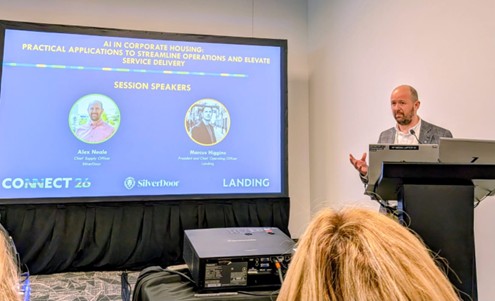
Pictured: Alex Neale Our Chief Supply Officer, showcasing his knowledge to a crowded room at CHPA Connect 26
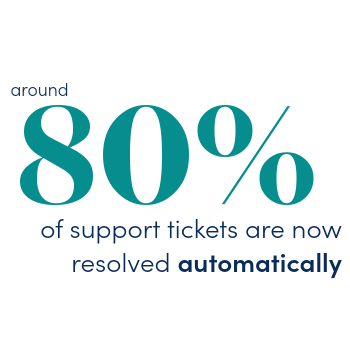
What made this session valuable for buyers and procurement professionals was not just the scale of what Landing achieved - it was the clarity of the roadmap Marcus laid out. His advice was simple: start with the decisions where you already have years of examples and clear rules. Support queries, extension requests, and maintenance issues all fit that description. Once those workflows are documented and uploaded to an AI agent, the automation almost builds itself.
He was equally candid about where AI has not delivered. Physical access logistics including gate systems, intercoms, and varied lock types across hundreds of properties remain stubbornly resistant to automation. Furniture fit assessments using AI floor plan tools proved unreliable in real world conditions. Alex added a human dimension to this: the goal of removing repetitive work is as much about staff dignity as efficiency. “If you have to tell someone a thousand times to try turning it off and on again,” he observed, “that’s pretty minimising.” These are honest, important limitations for procurement teams to understand when evaluating supplier capabilities.
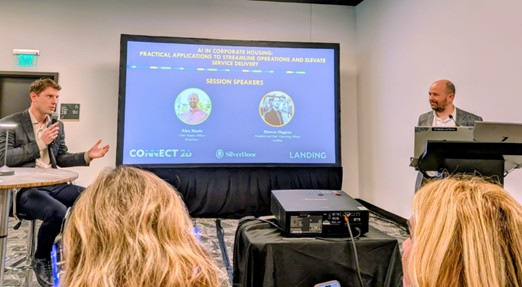
Pictured: L-R Marcus Higgins (Landing) and Alex Neale (SilverDoor) having a healthy debate on the challenges and opportunities that AI can offer
The broader takeaway for buyers: ask your housing providers not just whether they are using AI, but where. The most credible operators will be able to tell you precisely which workflows are automated, what data trains those systems, and where human judgment still takes over. Vague claims about "AI-powered operations" are not the same as demonstrated efficiency gains.
The Relationship Advantage Is Not Going Away
If the AI session was about operational excellence, Thom Singer's keynote, Creating Human Interaction in an AI World, was a timely counterweight. Singer, CEO of the Austin Technology Council and a certified speaking professional, made a case that will resonate with anyone in a service led industry: technology changes how we communicate, but it does not change what we are actually doing when we communicate.
His central argument was straightforward. People choose to work with the providers, suppliers, and partners they know, like, and trust. That selection process is not driven by automation - it is driven by shared experiences, consistent follow through, and the kind of relationship depth that only comes from genuine human engagement over time.
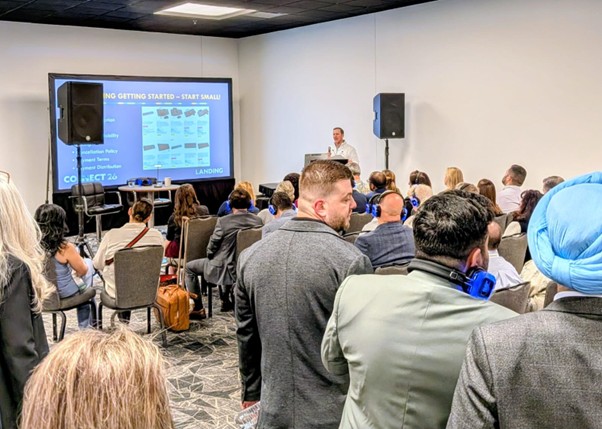
Pictured: Thom Singer, CEO of the Austin Technology Council, who discussed the best way to get started on your journey to AI integration
Singer cited research showing a significant decline in close professional friendships over recent decades, set against a backdrop of rising loneliness and increasing screen time. For corporate housing, an industry that, as every speaker at Connect acknowledged is fundamentally a relationship business, this has real commercial implications. The providers who invest in human connection, both with their clients and within their own teams, are building a form of competitive advantage that cannot be easily replicated or automated.
For procurement professionals, this framing is worth sitting with. The lowest cost provider is rarely the lowest risk provider. The relationships built through consistent service, transparent communication, and genuine care for guest experience are what deliver reliability when something goes wrong - and something always goes wrong. The question is who you want solving it.

The Synthesis: Technology in Service of People
The most important insight from CHPA Connect 2026 is not that AI is transforming corporate housing, nor that human relationships remain paramount. It is that both are true simultaneously and the providers navigating that tension most intelligently will define the next chapter of this industry.
As Marcus Higgins put it: “We still think it’s all about having great employees and pouring into our employees. What we want to do is give them tools so they can be working on the most valuable interactions - the human interactions.” Alex captured the same thought from a different angle: “Corporate housing is great for the human industry - and AI is there to make the human experience better.”
That is the lens through which SilverDoor approaches every aspect of our service model. We are investing in the technology that removes friction, accelerates information, and improves consistency. We are doing that precisely so that our people can show up fully for the conversations, the problem solving, and the relationship building that no algorithm can replicate.
What that looks like in practice is a service model that gives clients genuine choice - in how they communicate, how they structure their programs, and how they engage with us day to day. Technology should expand that optionality, not constrain it. When providers use automation to enforce uniformity rather than to free up their people to be more responsive and flexible, they risk creating exactly the kind of friction that pushes clients toward someone else. The goal is not a perfectly optimized system. It is a partnership that works the way the client needs it to work.

The corporate housing providers who will matter most to buyers in the years ahead are those who have understood that AI and human expertise are not competing priorities. They are complementary ones - and both are ultimately in service of the client's ability to do business on their own terms.
We left Austin energized and we look forward to continuing these conversations with our clients and partners.
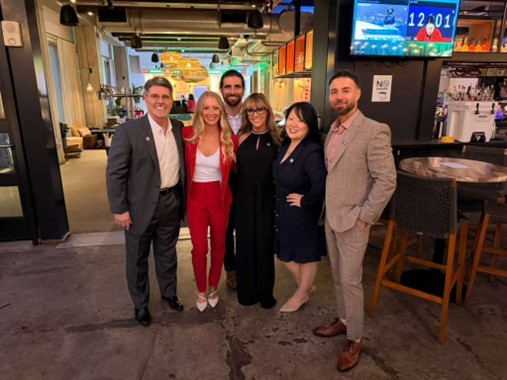
Pictured: L-R SilverDoor’s Richard Franco, Angela Mooney Barefield, Stephen Homesy, Tina Rosenberg, Chelsea Costa and Fernando Knapp. The team united, ready to celebrate with our partners after another brilliant CHPA Connect 26.